
Learn CPR
How to Use an AED, Step by Step
 By Gene Jolley, AHA Heartsaver® Instructor · October 2026
Real emergency right now? Call 911, start CPR, and send someone for the AED.
An AED, or automated external defibrillator, is a small portable device that can shock a stopped heart back into a normal rhythm. You'll find them in schools, gyms, churches, stores and many workplaces, usually in a wall cabinet with a heart and lightning bolt sign.
Here's the most important thing to know: an AED talks you through every step. It tells you where the pads go, when to stand back and when to push the button. It will only shock someone whose heart needs it. You can't use it wrong in a way that hurts the person.
Before the AED arrives
Call 911, send someone for the AED, and start Hands-Only CPR. Don't wait for the AED to start compressions. CPR keeps blood moving to the brain until the AED gets there.
The 4 steps
Turn it on
Set the AED next to the person's head and open the case. Press the power button, or just open the lid if that turns it on. Then listen and do what it says.
Two rescuers? One keeps doing compressions while the other opens the AED and gets the pads ready. Don't stop CPR until the pads are on.
Attach the pads
- Bare the chest. Open or cut the shirt. The pads have to touch skin.
- Make sure it's dry. Wipe off sweat or water.
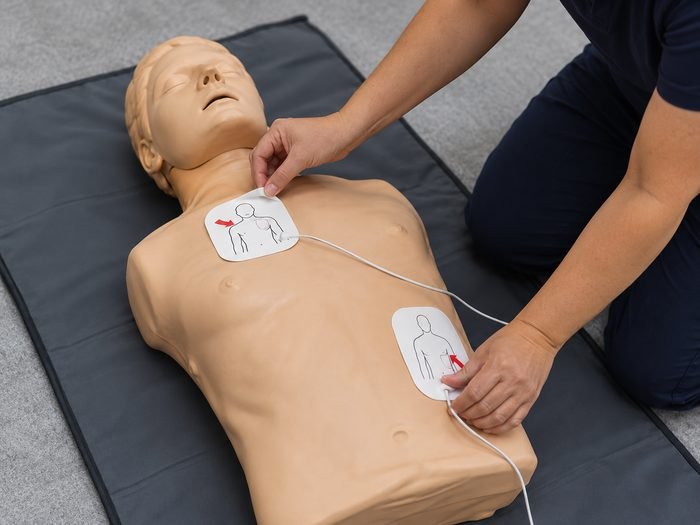
- Peel and stick. One pad on the upper right chest, just below the collarbone. The other on the lower left side, a few inches below the armpit.
- Plug in the cable if the AED asks you to. Many come already connected.
Can't remember where they go? Each pad has a picture showing exactly where it belongs.
Stand clear
- The AED will say it's analyzing. Stop CPR and make sure no one is touching the person.
- Say it out loud: "Everybody clear!" and look to be sure.
- If it says a shock is advised, make sure everyone is still clear and press the shock button. Some AEDs shock on their own after a countdown.
Restart CPR right away
- As soon as the shock is given, or if the AED says no shock is advised, start chest compressions again.
- Leave the pads on and the AED turned on. About every 2 minutes it will check the heart again and tell you what to do.
- Keep going until paramedics take over or the person starts to breathe normally or move.
"No shock advised" doesn't mean stop. It means the heart isn't in a rhythm a shock can fix. CPR is still the person's best chance.
Special situations
Water or snow
- Move the person out of standing water.
- Dry the chest before attaching pads.
- Wet ground or snow under the person is okay once the chest is dry.
Hairy chest
- Pads need to stick to skin.
- Many AED kits include a razor. Quickly shave where the pads go.
- If there's a spare set of pads, you can press one down and rip it off to remove hair.
Pacemaker or implanted device
- You may see a small bump under the skin, usually below the left collarbone.
- Don't put a pad directly on it. Place the pad about an inch away.
Medicine patches and jewelry
- Peel off any medicine patch where a pad goes and wipe the skin.
- Necklaces and bras can stay as long as the pads touch bare skin in the right spots. Move them aside if they're in the way.
Don't hesitate to use it on a woman
Studies show women who collapse in public are less likely than men to get CPR or an AED from a bystander. Often people worry about exposing someone's chest. Don't let that cost a life. Expose only what you need to get the pads on bare skin, and cover her with a jacket afterward if you can.
What about children?
If the AED has child pads or a child switch, use them for kids under 8. If it doesn't, adult pads are okay. Just make sure the pads don't touch or overlap. On a small child, that may mean one pad on the front of the chest and one on the back.
Want gear for your car or home? See the CPR masks and emergency supplies I recommend to my students.
See Safety GearWhy I teach this
After my own six-bypass surgery in 2023, I think about the minutes between a heart stopping and help arriving. An AED is one of the best tools anyone can have in those minutes, and most people have walked past one a hundred times without knowing how simple it is to use. In my classes, everyone practices with an AED trainer until it feels routine. Read my story.
Learn more from trusted sources
- Hands-Only CPR: the American Heart Association's official page, with short how-to videos
- How to Apply AED Pads: pad placement for adults and children, from HSI
Practice it once, and you'll remember it
In a hands-on class, you'll attach pads, hear the voice prompts and deliver a practice shock on a trainer, so the real thing feels familiar.
See CPR & AED classesThis guide is for general education and follows American Heart Association guidance for adults. Always follow the instructions of your specific AED and the 911 dispatcher. It does not replace a hands-on CPR and AED course. Twin State Safety is an independent training business; Heartsaver is a registered trademark of the American Heart Association.